As much as I've come to terms with not getting into University, and as much as I love my gap year job(s) (and the money), I am still rather worried.
I don't mean worried about repeating the same 'Oh, you know... I didn't get into University' routine (although it is a recurrent nightmare of mine) - I'm worried that I'll forget how to be a student. After all, working post-A Levels is pretty easy: I have very few bills to pay and none of the stress that comes with it; my working day finishes at 3.15 and then I work part-time taking children swimming, horse riding, feeding the ducks etc and once I've finished work, my time is my own. I have no homework, my University application is done and I'm not fretting over job applications. The days of poring over textbooks until 11pm are gone. For now at least.
For some reason, I have thrown myself particularly vigorously into preparation for my Cardiff interview and it's taken some getting used to! My procrastination is worse than ever, and I'm generally very demotivated to revise (although this could be due to Xmas break). After a week or so of complaining, I've fallen back into my familiar pattern of planning my revision tasks meticulously, creating detailed notes and brainstorm diagrams that can be used right up until I am called into the interview rooms. And the reason why this is particularly bizarre behaviour is that a Cardiff interview is almost unique in that in encompasses a chat about yourself. That's it. There's no test on chemical compounds, or tricky analyses of recent news stories, or Oxbridge-style brain teasers. Cardiff are interested in finding out about you, expanding on your personal statement and hearing you speak naturally about yourself and your interests.
Of course, there's very likely to be the standard 'Why Medicine?', 'Why Cardiff?' but any medical student wannabe worth their stethoscope should have these carefully pre-prepared. (In short, Medicine is a vocation that combines science and psychology with a person-centered focus and has the common goal of bettering others' lives. Medics are constantly relearning and learning new material, as well as reflecting and increasing their personal growth to become life-long learners. Cardiff practice dissection, to me, essential for developing respect and appreciation for the physical aspects of patients. There's a nursing module in Year 2, opportunities to intercalate a degree and a Senior Clinical Project in Year 5 as well as the usual Elective.)
I've heard rumours that a basic understanding of the Welsh NHS (operates seperately but still very congruent with English NHS, free prescriptions and a reform in 2009) and knowledge of recent news articles may be important. But the vast majority is exploring the PS - of course, this has the dual function of allowing candidates to expand on topics in a way they may not have been able to on paper (e.g. my work experience at GWH and volunteering wasn't even mentioned and my recently-changed employment status may need some explaining) and sussing out candidates who may have taken a certain artistic licence with their claims.
So the next part of Operation: Interview is to go through my statement with a toothcomb, writing my own notes on how to expand each statement so I have some pre-prepared thoughts should I be asked about anything on it. For my opening 'Why I want to be a doctor?' paragraph I've brainstormed further reasons, linked these together and tried to find practical examples (such as 'I found the physiology of nerve transmission fascinating during my A Level Biology course, but even more interesting when you consider nerve function to be the root of all movement, thought, emotion, memory and unconscious responses such as breathing and blinking'). Something I was told at my practice Oxfizz interview was to develop my skill of cross-linking ideas. So when I am asked about my Extended Project on the Psychology Of Tribal Medicine, I can drop in how the contrast in atmosphere at the Prospect Hospice and local hospital (both of which I have volunteered at) produce different feelings in patients which may in turn affect their perception of their illness, much as my report suggests.
Of course, it's all well and good to practice and rehearse in my bedroom, but something quite different when you're in the actual situation... As well as nerves, interviewers can word questions unexpectedly, may push for a particular answer or challenge a point of view or may want to spend the whole 30 minutes discussing the finer details of your journey in. We'll see.
The interview is next Tuesday, and like Hull York Medical School, Cardiff aim to give out offers/rejections by the end of February. The statistics for these kind of things are always interesting - I believe there are around 3000 applicants for Cardiff's 280 places. That's a statistical chance of around 1/10 at application. Around 900 people are then interviewed, so about 3 people per place but (and this is the part people forget) around 450-500 offers are given out, increasing your chance to around 1/2. Not quite as high as HYMS' 2/3, but it's certainly a relieving thought going into interview.
Showing posts with label interview prep. Show all posts
Showing posts with label interview prep. Show all posts
Tuesday, 3 January 2012


Wednesday, 28 December 2011
Wreck.
Apart from the ridiculous journey, Hull went okay. Ish. For an interview, anyway.
HYMS interviews are a pretty set procedure for everybody - seven questions on very set topics, plus your opinion of an article you've just read. I'm not allowed to discuss what was asked - but HYMS very helpfully provide a list of 'example' questions on their website, which are conveniently very similar to many of the questions I was asked.
Unlike anywhere else I've been, HYMS include a tour of their campus as part of your interview - the campus is really lovely, and the accomodation is as well. The student house we looked around backed directly on to the campus and housed five people with all bills included as well as a cleaner. An extra large room here (which was pretty enormous) cost £72 per week; which I thought was pretty fair! Even my taxis around Hull were cheap, so I do think it would make a perfect student-budget city.
After our interviews we were shown a presentation 'persuading' us to choose HYMS, should we receive more than one offer. Interestingly from the 1100 applicants, 800 passed the academic criteria (meaning 300 applied to a Uni they couldn't get in to?!). 450 were invited to interview on of these 290 of us will be offered a place. This means that my chance of success now is around the 2/3 mark. Which is reassuring, particularly compared to somewhere like Leeds where my chances are around 1/16.
(Also, we were told that each year around 50% of applicants to Medical School in the UK don't receive any offers - so now I don't feel too bad about my rejections last year.)
The reflex question for everybody to ask is 'so how do you think you did?' It's a really hard call; I felt I answered all the questions reasonably well, and had very few 'Doh!' moments. However, you come out and everybody seems to have given the same answers to the questions! A couple of questions were reiterated to me, as I hadn't fully addressed all aspects that they had asked for, but for others I tried to give a very balanced, full answer which often ended with 'however I feel your question is too broad to give you a specific answer'. I know that, despite my 'ultra-cool' demeanour in the holding room, I become very nervous and can appear quite flustered and edgy. I guess they know you're nervous. The one question I can say I answered really well was based around the standard 'Why do you want to study here?' and this is where my interview prep really paid off.
Each interview has to be prepped for differently - at HYMS your interview is completely seperate to your personal statement score, so there's no need to analyse your statement and second guess what's going to be asked. Like all interviews, I expected the 'Why do you want to come here?' and the general probing of my awareness of current medical issues; but they're hardly expecting you to be familiar with every piece of research. I keep up-to-date by reading the NHS' Behind the Headlines website every so often and listening to the news occasionally. In terms of HYMS specific prep, I spent an hour or so each night for a week reading and poking around on the Medical Schools' website.
But that's it. I find out at the end of February. As a very pleasant surprise, I received an invite for interview at Cardiff next month (the email arrived the day before Hull, so was a good nerve-settler). Cardiff is very different in terms of interview technique and requires lots of prep... so that's my holiday homework (although at least I'm not revising for January exams!!)
Hope you've had a good Christmas!
HYMS interviews are a pretty set procedure for everybody - seven questions on very set topics, plus your opinion of an article you've just read. I'm not allowed to discuss what was asked - but HYMS very helpfully provide a list of 'example' questions on their website, which are conveniently very similar to many of the questions I was asked.
Unlike anywhere else I've been, HYMS include a tour of their campus as part of your interview - the campus is really lovely, and the accomodation is as well. The student house we looked around backed directly on to the campus and housed five people with all bills included as well as a cleaner. An extra large room here (which was pretty enormous) cost £72 per week; which I thought was pretty fair! Even my taxis around Hull were cheap, so I do think it would make a perfect student-budget city.
After our interviews we were shown a presentation 'persuading' us to choose HYMS, should we receive more than one offer. Interestingly from the 1100 applicants, 800 passed the academic criteria (meaning 300 applied to a Uni they couldn't get in to?!). 450 were invited to interview on of these 290 of us will be offered a place. This means that my chance of success now is around the 2/3 mark. Which is reassuring, particularly compared to somewhere like Leeds where my chances are around 1/16.
(Also, we were told that each year around 50% of applicants to Medical School in the UK don't receive any offers - so now I don't feel too bad about my rejections last year.)
The reflex question for everybody to ask is 'so how do you think you did?' It's a really hard call; I felt I answered all the questions reasonably well, and had very few 'Doh!' moments. However, you come out and everybody seems to have given the same answers to the questions! A couple of questions were reiterated to me, as I hadn't fully addressed all aspects that they had asked for, but for others I tried to give a very balanced, full answer which often ended with 'however I feel your question is too broad to give you a specific answer'. I know that, despite my 'ultra-cool' demeanour in the holding room, I become very nervous and can appear quite flustered and edgy. I guess they know you're nervous. The one question I can say I answered really well was based around the standard 'Why do you want to study here?' and this is where my interview prep really paid off.
Each interview has to be prepped for differently - at HYMS your interview is completely seperate to your personal statement score, so there's no need to analyse your statement and second guess what's going to be asked. Like all interviews, I expected the 'Why do you want to come here?' and the general probing of my awareness of current medical issues; but they're hardly expecting you to be familiar with every piece of research. I keep up-to-date by reading the NHS' Behind the Headlines website every so often and listening to the news occasionally. In terms of HYMS specific prep, I spent an hour or so each night for a week reading and poking around on the Medical Schools' website.
But that's it. I find out at the end of February. As a very pleasant surprise, I received an invite for interview at Cardiff next month (the email arrived the day before Hull, so was a good nerve-settler). Cardiff is very different in terms of interview technique and requires lots of prep... so that's my holiday homework (although at least I'm not revising for January exams!!)
Hope you've had a good Christmas!
Wednesday, 23 March 2011
Procrastinating.
It's most A Level students biggest vice. And it's kind of nearly always preferable to revising the Krebs cycle.
But what about ways to positively procrastinate? Which is almost an oxymoron.
So.. what do I do when I'm trying not to stress about which Uni's haven't replied to me yet *ahem, Bristol I mean you* which A Levels are too difficult and what to do on my gap year?
Reading
Books seem like a pretty good time-wasting tool. I mean, they make you look intelligent and stuff, innit? Joke completely intended.
Here I thought I'd post a little list of things I've read over the last year which have some how contributed to my medical knowledgy persona type thing.
Suburban Shaman by Cecil Helman
 There's lots of books that practically every medical student wannabe has read and this isn't one of them.
I stumbled across this gem as part of my Extended Project (on the Psychology of Tribal Healing don't you know?) and absolutely loved it, possibly more than the other more mainstream books I've read as prep.
Cecil Helman is the author of a famous textbook called Culture, Health and Illness which is used by most medical schools, and Helman himself studied both medicine and anthropology which he combines in his career as a GP in London (I believe it's London - I did read this nearly a year ago).
Anyway, the book essentially tells the story of how Helman became interested in anthropology (mostly due to his experiences as a medical student in South Africa pre-apartheid) and offers examples of how lateral thinking and cultural awareness can be appplied in British healthcare.
A particularly memorable example was of an Indian lady who presented with symptoms of paranoia and some seemingly random story of love and grudges and family hatred. She would most likely be prescribed antidepressants (apparently) but Helman instead suggested she visit an Ayurveda healer who cures her by explaining and treating her illness in ways that comply with her cultural background.
Essentially, it's all very interesting.
The Immortal Life of Henrietta Lacks by Rebecca Skloot


Tricks of the Mind by Derren Brown
Bit of an odd choice but bear with me. I didn’t actually pick this up for any career-related purpose; I just really like Derren Brown.
 Well, that’s a bit of an untruth... My two main interests in medicine at the moment are 1) medical anthropology, hence the extended project and 2) the interaction of body and mind, including mental disorders, hallucinations, psychosomatic disorders, stress disorders etc. Also, there is a clear link between the two topics.
Derren’s book is mostly about techniques he has learnt and acquired which involve manipulating the normal abilities of the mind. I’m not going to lie, I’m only halfway through at the moment, but there’s some interesting stuff on ideomotor movements and some fabulous memory techniques which would be very useful for any A Level student crammer. And I’m also going to watch Derren’s show next month and wanted some insider information.
Trust Me: I’m a Junior Doctor by Max Pemberton*
 I’m not going to lie; this is sat on my desk unopened, but I have every intention of reading it at some point. A word of warning: from what I’ve heard about this book it’s very popular with wannabe medical students, but not the most flattering text to quote in an interview/personal statement.
*Also, the fact that I misquoted the title in my original blog probably says something about my motivation to read it. Or Freud would say it references some sexual desire. Who knows.
AND, part of this blog is I want it to feel like a community- medical wannabes helping eachother out... so if you've read any good books, let me know...
But what about ways to positively procrastinate? Which is almost an oxymoron.
So.. what do I do when I'm trying not to stress about which Uni's haven't replied to me yet *ahem, Bristol I mean you* which A Levels are too difficult and what to do on my gap year?
Reading
Books seem like a pretty good time-wasting tool. I mean, they make you look intelligent and stuff, innit? Joke completely intended.
Here I thought I'd post a little list of things I've read over the last year which have some how contributed to my medical knowledgy persona type thing.
Suburban Shaman by Cecil Helman

I stumbled across this gem as part of my Extended Project (on the Psychology of Tribal Healing don't you know?) and absolutely loved it, possibly more than the other more mainstream books I've read as prep.
Cecil Helman is the author of a famous textbook called Culture, Health and Illness which is used by most medical schools, and Helman himself studied both medicine and anthropology which he combines in his career as a GP in London (I believe it's London - I did read this nearly a year ago).
Anyway, the book essentially tells the story of how Helman became interested in anthropology (mostly due to his experiences as a medical student in South Africa pre-apartheid) and offers examples of how lateral thinking and cultural awareness can be appplied in British healthcare.
A particularly memorable example was of an Indian lady who presented with symptoms of paranoia and some seemingly random story of love and grudges and family hatred. She would most likely be prescribed antidepressants (apparently) but Helman instead suggested she visit an Ayurveda healer who cures her by explaining and treating her illness in ways that comply with her cultural background.
Essentially, it's all very interesting.
The Immortal Life of Henrietta Lacks by Rebecca Skloot

I felt really mixed about this book – Skloot’s clearly tried to blend the science behind Henrietta’s story into the main focal point which is the humanistic element. Which is fine, except it feels really lost at times.
For those that haven’t heard of Henrietta Lacks, essentially her cells were the first human cells to be successfully grown in a laboratory – and they never stopped. They were used for all sorts of experimental purposes: testing the effects of radiation and space travel, discovering the polio vaccine and developing in vitro fertilisation, yet Henrietta herself was never credited or even gave consent for her tissue to be used.
This in itself is fascinating enough; the ethics surrounding consent and the treatment of black people is explained at great lengths – drawing on famous studies (such as the Tuskegee syphilis study) and unique lawsuits. All of this, Skloot writes about brilliantly.
What isn’t so brilliant is the weirdly obsessive, rambling chapters about Skloot’s surviving daughter, Deborah. I understand the human interest behind a novel like this but surely that human interest should revolve around Henrietta and what she had to endure, rather than her children? Just saying.
Oh, and as a side note I thought you’d like to know my absolute favourite quote from the book, although I’m not sure why it’s so interesting to me; I think it’s the internal clinician, the fascination with the human body as a mechanism, and the understanding of how, and why, things can be broken beyond repair.
“Tumours the size of baseballs had nearly replaced her kidneys, bladder, ovaries, and uterus. And her other organs were so covered in small white tumours it looked as if someone had filled her with pearls.”
Tribe by Bruce Parry
Again, this was a book I read as part of my extended research project. It focuses primarily on the anthropology of different tribes, as opposed to anything medical related but I still found it very interesting.
If you view the book as a whole, it gives an insightful commentary into the dynamic nature of human existence; the way in which social structure and culture has developed in different areas, and the themes that are common to all, namely; love, family and health.

There are a couple of chapters that do touch on medical anthropology, but not much. However, one of the best chapters (if you can call it that) was on the practice of FGM. FGM, or female genital mutilation, is condemned by the Western world and most international health organisations. The practice is mostly carried out in small village tribes by an untrained elder using rudimentary instruments; making it unhygienic, agonising and extremely dangerous. It is easy to be disgusted by such practice as a Westerner, yet to empathise with these individuals and truly understand them is much harder.
I won’t go into a huge analysis or debate on the topic, partly because I’ve already covered it in my own project but also because I think sometimes controversial topics are best answered by personal reflection and contemplation. So I’ll leave you this quote to contemplate, it’s from an elder, after being asked why FGM is still practiced in this particular tribe:
“It’s the most important tradition for us... changing our culture about this is impossible... If a woman with a clitoris gives birth, she, her child and everyone will die. Her clitoris will come up to her head. It’ll come out of her nose and then back into her head. It’ll kill her; she’ll die. Her father will die, her mother will die. That is why we cannot stop circumcising girls.”
Tricks of the Mind by Derren Brown
Bit of an odd choice but bear with me. I didn’t actually pick this up for any career-related purpose; I just really like Derren Brown.

Derren’s book is mostly about techniques he has learnt and acquired which involve manipulating the normal abilities of the mind. I’m not going to lie, I’m only halfway through at the moment, but there’s some interesting stuff on ideomotor movements and some fabulous memory techniques which would be very useful for any A Level student crammer. And I’m also going to watch Derren’s show next month and wanted some insider information.
Trust Me: I’m a Junior Doctor by Max Pemberton*
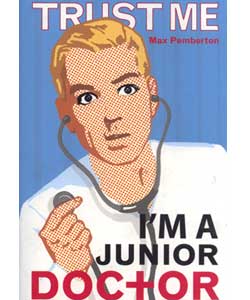
*Also, the fact that I misquoted the title in my original blog probably says something about my motivation to read it. Or Freud would say it references some sexual desire. Who knows.
AND, part of this blog is I want it to feel like a community- medical wannabes helping eachother out... so if you've read any good books, let me know...
Subscribe to:
Posts (Atom)