Morning! Unusual for me to post a quick, little blog but I'm really trying very hard to keep myself busy before Thursday (I find it holds back the worry a little easier...) I'm also waiting to go to work. Found two Psychology articles that you might find interesting this morning.
Firstly, a report on the prevalence of autism (which provokes an interesting discussion on how careful parents should be when considering a second child).
And also a very interesting study on evolution complete with a lovely picture of a killer rat.
Enjoy.
Showing posts with label psychology. Show all posts
Showing posts with label psychology. Show all posts
Tuesday, 16 August 2011


Sunday, 3 July 2011
Optimist.
I promise that my apparent laziness was completely intended. I like so totally meant to not write for two weeks. Honestly.
And this is because I have had some fantastic news!
So, my last blog post was a sarcastic little dig at the whiney exam students and I had my Psychology exam left to go. Psychology was fine; it's a bizarre subject where you can kind of 'make it up as you go along'. I'm awful at remembering exam content after I leave the hall, but I do know that most of my (extremely effective ;) revision consisted of YouTube
I can't remember quite how much complaining I've done in these blogs RE: gap year jobs but if you ask Jordan you'll realise I've been pretty stressed about the whole thing.
The cliché medical gap year job tends to involve lots of cleaning out bed pans, sick and dribble - namely Nursing Auxiliary work. But this doesn't have to be the case- lots of roles within the NHS require little more than good GCSE's and enthusiasm, and can provide diverse work, from roles on the wards as Nursing Auxiliaries/Assitants to admin/HR and technician work 'behind the scenes' in a hospital. In addition, Health Care Assistants and Phlebotomists work both in hospitals and general practices and again, require little more than a good standard of education.
If this is the type of thing you're looking for, a good place to start is reading the job descriptions on the NHS careers website before searching for jobs on the NHS job site. They can also set you up a daily email with relevant jobs in your area (this was perfect as it narrowed down roles quickly and efficiently).
Sounds fantastic right? I was thinking I could swan into a job easily, get myself sorted for the year, learn a few clinical skills, brilliant. The main piece of advice I would offer is prepare for some intense competition. Although all jobs are listed with a closing date, they will close as soon as sufficient applications are received - this can be as little as 24 hours. Most roles will specify desirable and essential characteristics. 'Desirable' tends to include healthcare type qualifications and experience in the NHS - without these (like me) I think it can be difficult to secure a job.
But don't let that put you off - Friday I received a letter inviting me for an interview at Cirencester hospital as a Health Care Assistant. Unfortunately, I've had to decline due to other job offers...
However, when I spoke to Cardiff University they made it clear that they do not necessarily expect prospective students to take doctor-in-training jobs for their gap year. I.e. a job working in the NHS, whilst showing commitment, is not necessary; many, many different jobs, if written about carefully, can demonstrate a multitude of skills including communication, empathy, understanding and teamwork.
The way in which you choose to interpret Cardiff's opinion is up to you - personally, I wouldn't feel comfortable working in a shop or office for a year and then claiming it's made me a better clinician. Conversely, I wouldn't want to take a NHS job just to look like the model student. If you are really stuck about what to do, just apply for everything. Your local council website (Swindon's is here) should list job vacancies in your area. Although you'll probably also want to look at more generic job searches, council positions tend to be more focused on health and social care services and may offer some inspiration.
The route I've decided to go down is work involving disabled children, mostly inspired by my voluntary work with The Chalet School. The week before last I was offered a position with the council, working with disabled children and young adults through the holidays as a 'sessional worker' - basically my purpose is to help stimulate and occupy these children through means of play sessions and day visits. And then last week I was lucky enough to be offered a role at a Swindon school as a SEN (Special Needs) Teaching Assistant, with added responsibility of working with autistic children.
I'm extremely excited and hopeful for the new roles; I know they will be challenging, particularly working as a TA in a school with a sixth form- where some students are as old as I am- but I am aware of just how lucky I am to be given this opportunity and anyway, I love a challenge.
*PLUS, I get to wear 'teacher' clothes- like little blouses and cute court shoes and I'm genuinely equally as excited for my new wardrobe; there almost definately will be a 'workwear' blog coming soon!
And this is because I have had some fantastic news!
So, my last blog post was a sarcastic little dig at the whiney exam students and I had my Psychology exam left to go. Psychology was fine; it's a bizarre subject where you can kind of 'make it up as you go along'. I'm awful at remembering exam content after I leave the hall, but I do know that most of my (extremely effective ;) revision consisted of YouTube
I can't remember quite how much complaining I've done in these blogs RE: gap year jobs but if you ask Jordan you'll realise I've been pretty stressed about the whole thing.
The cliché medical gap year job tends to involve lots of cleaning out bed pans, sick and dribble - namely Nursing Auxiliary work. But this doesn't have to be the case- lots of roles within the NHS require little more than good GCSE's and enthusiasm, and can provide diverse work, from roles on the wards as Nursing Auxiliaries/Assitants to admin/HR and technician work 'behind the scenes' in a hospital. In addition, Health Care Assistants and Phlebotomists work both in hospitals and general practices and again, require little more than a good standard of education.
If this is the type of thing you're looking for, a good place to start is reading the job descriptions on the NHS careers website before searching for jobs on the NHS job site. They can also set you up a daily email with relevant jobs in your area (this was perfect as it narrowed down roles quickly and efficiently).
Sounds fantastic right? I was thinking I could swan into a job easily, get myself sorted for the year, learn a few clinical skills, brilliant. The main piece of advice I would offer is prepare for some intense competition. Although all jobs are listed with a closing date, they will close as soon as sufficient applications are received - this can be as little as 24 hours. Most roles will specify desirable and essential characteristics. 'Desirable' tends to include healthcare type qualifications and experience in the NHS - without these (like me) I think it can be difficult to secure a job.
But don't let that put you off - Friday I received a letter inviting me for an interview at Cirencester hospital as a Health Care Assistant. Unfortunately, I've had to decline due to other job offers...
 |
| NB. This isn't standard NHS uniform. |
The way in which you choose to interpret Cardiff's opinion is up to you - personally, I wouldn't feel comfortable working in a shop or office for a year and then claiming it's made me a better clinician. Conversely, I wouldn't want to take a NHS job just to look like the model student. If you are really stuck about what to do, just apply for everything. Your local council website (Swindon's is here) should list job vacancies in your area. Although you'll probably also want to look at more generic job searches, council positions tend to be more focused on health and social care services and may offer some inspiration.
The route I've decided to go down is work involving disabled children, mostly inspired by my voluntary work with The Chalet School. The week before last I was offered a position with the council, working with disabled children and young adults through the holidays as a 'sessional worker' - basically my purpose is to help stimulate and occupy these children through means of play sessions and day visits. And then last week I was lucky enough to be offered a role at a Swindon school as a SEN (Special Needs) Teaching Assistant, with added responsibility of working with autistic children.
I'm extremely excited and hopeful for the new roles; I know they will be challenging, particularly working as a TA in a school with a sixth form- where some students are as old as I am- but I am aware of just how lucky I am to be given this opportunity and anyway, I love a challenge.
*PLUS, I get to wear 'teacher' clothes- like little blouses and cute court shoes and I'm genuinely equally as excited for my new wardrobe; there almost definately will be a 'workwear' blog coming soon!
Wednesday, 27 April 2011
Derren.
You cannot comprehend just how excited I am even to be writing this blog.
All week I have been mentally planning for this: My Review of Derren Brown's Latest Tour: Svengali. It is very exciting stuff indeed.
For anyone who isn't familiar with the name, Derren describes himself as a 'psychological illusionist'; his shows involve startling feats of apparent 'mindbending' and illusions which combine magic, suggestion, psychology, misdirection and showmanship. And if you still don't know who I mean: don't worry. I'll be making it perfectly clear during this blog.
Derren's work fascinates me; it's an intelligent form of entertainment where the audience are invited to speculate and ponder and make genuine 'how does he do that?!' comments. Rather unlike most of the trite on television nowadays (Yes I mean you, 'The Only Way Is Essex') Also, as a psychology student and aspiring psychiatrist (or at least doctor) anything to do with cognition, perception and mental behaviour interests me.
Finally, I would love to fully review and discuss the Svengali live show but Derren makes a specific point about not revealing it to anyone else - which makes sense. Even from reading his book 'Tricks of the Mind' which explains some of the techniques used to perform certain illusions ruined it a teeney bit, I was too busy trying to figure everything out to just enjoy it for what it was. Anyway, so as I can't tell you what actually happens I'm going to draw comparisons with some of Derren's other work - and if you are trying to decipher the show's content from this then good luck, I think I'm just as practiced at misdirection as the man himself.
Svengali Review: Oxford New Theatre, 20th April 2011
I haven't even got to the part where the curtain goes up and the show begins but already I can't tell you about two fairly important parts of the show, pre-curtain, if you like.
So when the show does begin, the curtain goes up and the very first trick/piece begins. A classic piece of psychology and suggestion, intermingled with Derren's very unique sense of comedy. For something similar, take a look at this clip from 'An Evening of Wonders'; to get a sense of the whole trick (in our show it isn't split like it is here) watch the first six minutes of this and then watch this one. Alternatively, if you're feeling lazy just watch the second bit.
The next section of the show involves Derren's spookily accurate talent of 'reading' people - using tiny clues in the way a person behaves to deduce information about them. From trawling through YouTube it seems it's the type of trick he's most often asked to perform on chat shows (it's quick and easy to understand) but the following has to be my absolute favourite reaction to any 'mind-reading' trick ever.
There's lots of these videos on the internet but this is another personal favourite, just because it demonstrates 'reading' in a slightly different way but first gives a good example of suggestion - where a person believes they have chosen a name/word/letter freely but in fact were influenced by outside signals.
All week I have been mentally planning for this: My Review of Derren Brown's Latest Tour: Svengali. It is very exciting stuff indeed.
For anyone who isn't familiar with the name, Derren describes himself as a 'psychological illusionist'; his shows involve startling feats of apparent 'mindbending' and illusions which combine magic, suggestion, psychology, misdirection and showmanship. And if you still don't know who I mean: don't worry. I'll be making it perfectly clear during this blog.
Derren's work fascinates me; it's an intelligent form of entertainment where the audience are invited to speculate and ponder and make genuine 'how does he do that?!' comments. Rather unlike most of the trite on television nowadays (Yes I mean you, 'The Only Way Is Essex') Also, as a psychology student and aspiring psychiatrist (or at least doctor) anything to do with cognition, perception and mental behaviour interests me.
Finally, I would love to fully review and discuss the Svengali live show but Derren makes a specific point about not revealing it to anyone else - which makes sense. Even from reading his book 'Tricks of the Mind' which explains some of the techniques used to perform certain illusions ruined it a teeney bit, I was too busy trying to figure everything out to just enjoy it for what it was. Anyway, so as I can't tell you what actually happens I'm going to draw comparisons with some of Derren's other work - and if you are trying to decipher the show's content from this then good luck, I think I'm just as practiced at misdirection as the man himself.
Svengali Review: Oxford New Theatre, 20th April 2011
I haven't even got to the part where the curtain goes up and the show begins but already I can't tell you about two fairly important parts of the show, pre-curtain, if you like.
So when the show does begin, the curtain goes up and the very first trick/piece begins. A classic piece of psychology and suggestion, intermingled with Derren's very unique sense of comedy. For something similar, take a look at this clip from 'An Evening of Wonders'; to get a sense of the whole trick (in our show it isn't split like it is here) watch the first six minutes of this and then watch this one. Alternatively, if you're feeling lazy just watch the second bit.
The next section of the show involves Derren's spookily accurate talent of 'reading' people - using tiny clues in the way a person behaves to deduce information about them. From trawling through YouTube it seems it's the type of trick he's most often asked to perform on chat shows (it's quick and easy to understand) but the following has to be my absolute favourite reaction to any 'mind-reading' trick ever.
There's lots of these videos on the internet but this is another personal favourite, just because it demonstrates 'reading' in a slightly different way but first gives a good example of suggestion - where a person believes they have chosen a name/word/letter freely but in fact were influenced by outside signals.
I'm sure I could find a clip that represents almost every trick in Svengali (seeing as they're all based on the same five key skills: magic, suggestion, misdirection, psychology and showmanship) if I really tried. But anyone who cares to look at the Derren Brown section of Channel 4 On Demand will realise the vast amount of video available, spanning a 10 year career. Therefore I've picked the clips that I remember best to illustrate each point.
The following is years old but definately echoes an extremely impressive 'audience-wide' trick performed near to the interval of Svengali. Although I would obviously recommend watching the whole thing, the part I'm referring to is from 14:20 onwards. Enjoy.
The only other thing I can refer you to in the first half is the infamous Russian Roulette stunt which draws some visual comparison, if nothing else.
So now we're at the interval. There's a small fire burning on stage, but don't worry about that; fetch yourself an extortionately priced pot of ice-cream and round of drinks, queue for the toilets and get back to your seats for the second half. If you're confused; that's the point. I don't want to tell anyone what happens, just stoke your curiosity with some relevant, if misleading references.
Right, the lights are down and the curtain comes up. Honestly, the bulk of the next half is difficult to explain; if you've seen any of Derren's other live shows (and I suggest you watch on 4OD) then you'll know the second half tends to involve a more theatrical piece, with historical references. Without giving the game away (clue: you're likely to have Googled Svengali at this point, and it might seem relevant.... or maybe not) there's nothing specific I can say. Instead, have a look at Derren's other second-half openers; Table-Tipping at 36.00 in Evening of Wonders, psychic abilities from 46.00 in Enigma (possibly very relevant?) and impressive memory skills from 28.00 in The Gathering. Also, just before this section there is a good example of large-scale hypnosis. Combined with a common stage-hypnotist-in-Magaluf style trick it was very succesfull on certain audience members. As a side-note, the ending of The Gathering is worth a watch. This doesn't happen in Svengali, you'll be pleased to know; waste of bloody money.
Another clip I was instantly reminded of was of Robbie Williams in an episode of Derren's 'Trick of the Mind' series. You can watch it here. It's my favourite, just because there's something so heauntingly beautiful about it all. If pain and perception does interest you, there's a longer sequence in this Mind Control episode, as well as one of my favourite suggestion tricks with advertising directors.
The ending of the show was so spectacularly unique I really have nothing to compare it to. It was clever and witty, with Derren's characteristic style of letting everything not seem quite as it really is.
Essentially, the show was incredible; I would fully recommend it to anyone. The combination of excitement, anticipation and wonderment makes for tense and absorbing viewing. I personally am hooked on Derren's material - there's a huge backcatalogue available for viewing online as well as two books for those who like to delve a little deeper into the why's and wherefore's.
I really hope you've enjoyed reading this and have watched at least a few of the clips presented here (I know there's an awful lot!). And if you still have an insatiable thirst for all things Derren I'd recommend watching The Heist. It's my favourite. (Especially because it references Milgram)
Wednesday, 23 March 2011
Procrastinating.
It's most A Level students biggest vice. And it's kind of nearly always preferable to revising the Krebs cycle.
But what about ways to positively procrastinate? Which is almost an oxymoron.
So.. what do I do when I'm trying not to stress about which Uni's haven't replied to me yet *ahem, Bristol I mean you* which A Levels are too difficult and what to do on my gap year?
Reading
Books seem like a pretty good time-wasting tool. I mean, they make you look intelligent and stuff, innit? Joke completely intended.
Here I thought I'd post a little list of things I've read over the last year which have some how contributed to my medical knowledgy persona type thing.
Suburban Shaman by Cecil Helman
 There's lots of books that practically every medical student wannabe has read and this isn't one of them.
I stumbled across this gem as part of my Extended Project (on the Psychology of Tribal Healing don't you know?) and absolutely loved it, possibly more than the other more mainstream books I've read as prep.
Cecil Helman is the author of a famous textbook called Culture, Health and Illness which is used by most medical schools, and Helman himself studied both medicine and anthropology which he combines in his career as a GP in London (I believe it's London - I did read this nearly a year ago).
Anyway, the book essentially tells the story of how Helman became interested in anthropology (mostly due to his experiences as a medical student in South Africa pre-apartheid) and offers examples of how lateral thinking and cultural awareness can be appplied in British healthcare.
A particularly memorable example was of an Indian lady who presented with symptoms of paranoia and some seemingly random story of love and grudges and family hatred. She would most likely be prescribed antidepressants (apparently) but Helman instead suggested she visit an Ayurveda healer who cures her by explaining and treating her illness in ways that comply with her cultural background.
Essentially, it's all very interesting.
The Immortal Life of Henrietta Lacks by Rebecca Skloot


Tricks of the Mind by Derren Brown
Bit of an odd choice but bear with me. I didn’t actually pick this up for any career-related purpose; I just really like Derren Brown.
 Well, that’s a bit of an untruth... My two main interests in medicine at the moment are 1) medical anthropology, hence the extended project and 2) the interaction of body and mind, including mental disorders, hallucinations, psychosomatic disorders, stress disorders etc. Also, there is a clear link between the two topics.
Derren’s book is mostly about techniques he has learnt and acquired which involve manipulating the normal abilities of the mind. I’m not going to lie, I’m only halfway through at the moment, but there’s some interesting stuff on ideomotor movements and some fabulous memory techniques which would be very useful for any A Level student crammer. And I’m also going to watch Derren’s show next month and wanted some insider information.
Trust Me: I’m a Junior Doctor by Max Pemberton*
 I’m not going to lie; this is sat on my desk unopened, but I have every intention of reading it at some point. A word of warning: from what I’ve heard about this book it’s very popular with wannabe medical students, but not the most flattering text to quote in an interview/personal statement.
*Also, the fact that I misquoted the title in my original blog probably says something about my motivation to read it. Or Freud would say it references some sexual desire. Who knows.
AND, part of this blog is I want it to feel like a community- medical wannabes helping eachother out... so if you've read any good books, let me know...
But what about ways to positively procrastinate? Which is almost an oxymoron.
So.. what do I do when I'm trying not to stress about which Uni's haven't replied to me yet *ahem, Bristol I mean you* which A Levels are too difficult and what to do on my gap year?
Reading
Books seem like a pretty good time-wasting tool. I mean, they make you look intelligent and stuff, innit? Joke completely intended.
Here I thought I'd post a little list of things I've read over the last year which have some how contributed to my medical knowledgy persona type thing.
Suburban Shaman by Cecil Helman

I stumbled across this gem as part of my Extended Project (on the Psychology of Tribal Healing don't you know?) and absolutely loved it, possibly more than the other more mainstream books I've read as prep.
Cecil Helman is the author of a famous textbook called Culture, Health and Illness which is used by most medical schools, and Helman himself studied both medicine and anthropology which he combines in his career as a GP in London (I believe it's London - I did read this nearly a year ago).
Anyway, the book essentially tells the story of how Helman became interested in anthropology (mostly due to his experiences as a medical student in South Africa pre-apartheid) and offers examples of how lateral thinking and cultural awareness can be appplied in British healthcare.
A particularly memorable example was of an Indian lady who presented with symptoms of paranoia and some seemingly random story of love and grudges and family hatred. She would most likely be prescribed antidepressants (apparently) but Helman instead suggested she visit an Ayurveda healer who cures her by explaining and treating her illness in ways that comply with her cultural background.
Essentially, it's all very interesting.
The Immortal Life of Henrietta Lacks by Rebecca Skloot

I felt really mixed about this book – Skloot’s clearly tried to blend the science behind Henrietta’s story into the main focal point which is the humanistic element. Which is fine, except it feels really lost at times.
For those that haven’t heard of Henrietta Lacks, essentially her cells were the first human cells to be successfully grown in a laboratory – and they never stopped. They were used for all sorts of experimental purposes: testing the effects of radiation and space travel, discovering the polio vaccine and developing in vitro fertilisation, yet Henrietta herself was never credited or even gave consent for her tissue to be used.
This in itself is fascinating enough; the ethics surrounding consent and the treatment of black people is explained at great lengths – drawing on famous studies (such as the Tuskegee syphilis study) and unique lawsuits. All of this, Skloot writes about brilliantly.
What isn’t so brilliant is the weirdly obsessive, rambling chapters about Skloot’s surviving daughter, Deborah. I understand the human interest behind a novel like this but surely that human interest should revolve around Henrietta and what she had to endure, rather than her children? Just saying.
Oh, and as a side note I thought you’d like to know my absolute favourite quote from the book, although I’m not sure why it’s so interesting to me; I think it’s the internal clinician, the fascination with the human body as a mechanism, and the understanding of how, and why, things can be broken beyond repair.
“Tumours the size of baseballs had nearly replaced her kidneys, bladder, ovaries, and uterus. And her other organs were so covered in small white tumours it looked as if someone had filled her with pearls.”
Tribe by Bruce Parry
Again, this was a book I read as part of my extended research project. It focuses primarily on the anthropology of different tribes, as opposed to anything medical related but I still found it very interesting.
If you view the book as a whole, it gives an insightful commentary into the dynamic nature of human existence; the way in which social structure and culture has developed in different areas, and the themes that are common to all, namely; love, family and health.

There are a couple of chapters that do touch on medical anthropology, but not much. However, one of the best chapters (if you can call it that) was on the practice of FGM. FGM, or female genital mutilation, is condemned by the Western world and most international health organisations. The practice is mostly carried out in small village tribes by an untrained elder using rudimentary instruments; making it unhygienic, agonising and extremely dangerous. It is easy to be disgusted by such practice as a Westerner, yet to empathise with these individuals and truly understand them is much harder.
I won’t go into a huge analysis or debate on the topic, partly because I’ve already covered it in my own project but also because I think sometimes controversial topics are best answered by personal reflection and contemplation. So I’ll leave you this quote to contemplate, it’s from an elder, after being asked why FGM is still practiced in this particular tribe:
“It’s the most important tradition for us... changing our culture about this is impossible... If a woman with a clitoris gives birth, she, her child and everyone will die. Her clitoris will come up to her head. It’ll come out of her nose and then back into her head. It’ll kill her; she’ll die. Her father will die, her mother will die. That is why we cannot stop circumcising girls.”
Tricks of the Mind by Derren Brown
Bit of an odd choice but bear with me. I didn’t actually pick this up for any career-related purpose; I just really like Derren Brown.

Derren’s book is mostly about techniques he has learnt and acquired which involve manipulating the normal abilities of the mind. I’m not going to lie, I’m only halfway through at the moment, but there’s some interesting stuff on ideomotor movements and some fabulous memory techniques which would be very useful for any A Level student crammer. And I’m also going to watch Derren’s show next month and wanted some insider information.
Trust Me: I’m a Junior Doctor by Max Pemberton*
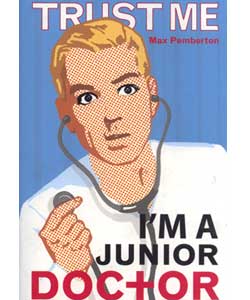
*Also, the fact that I misquoted the title in my original blog probably says something about my motivation to read it. Or Freud would say it references some sexual desire. Who knows.
AND, part of this blog is I want it to feel like a community- medical wannabes helping eachother out... so if you've read any good books, let me know...
Subscribe to:
Comments (Atom)