So after the tears of rejection, the bitterness of a gap year, and the denial by writing (irrelevantly) about Derren Brown I'm finally manning up.
I'm not really one to dwell much; usually I forget that I'm supposed to be angry about ABC or that I'm ignoring DEF. I think it's kind of, well... childish?
Generally, I'd much rather get on with my life and things that are important, than cry over spilt milk. So, for now, that involves revising for my exams (dull) and lookin for jobs (frustrating) and then applying for afore mentioned job (cumbersome) by writing an interesting and potentially career-securing statement (hand-aching).
Essentially, life isn't allowed to be interesting or exciting for the next few weeks as I spend all my time perusing the NHS careers website or the local council's job vacancy page. The most exciting thing to recently happen has been a sudden acquisition of books, which unfortunately I don't currently have time to read. Among them, a book on Mental Diseases written in 1898 and a fabulous book of quotations, collaborated by the producers of QI (possibly my favourite thing ever shown on television).
So, as an excuse to read I'll be peppering this with quotations. Hopefully philosophers regularly mention the dwindling job opportunities in the NHS.
Options
My biggest worry is what universities want from a gap year. It's mostly about proving your commitment and medical interest, which is easier said than done. Whilst at school, universities can't expect students to have committed more than a few hours a week volunteering, or maybe a week or two work experience placement. But a whole year to play with? That's a lot of potential.
Half our time is spent trying to do something with the time we have rushed through life trying to save - Will Rogers
The common preconception is that gap year students go travelling. Backpack. One way ticket. Hostels. Bar work. Diphtheria. You get the picture.
Which would be perfect, except travel requires money. And money is gained through work. So, work, save, leave, right? Well, apparently nothing is hated more by application reviewers than 'I'm planning on doing this...' or 'I'm hoping to do that...' They want concrete evidence. Preferably you've already done it. Or you're submitting your statement whilst trekking through the Borneo jungle. Or at the very least booked a plane ticket.
Which is difficult, when the application is written over the summer, directly after leaving college when nobody's had a chance to make any money yet... Ah.
And on a practical note, medical interviews can range from November through to April time, with very little warning. Meaning being abroad risks a last-minute trip home for an interview. Nightmare.
Sooner or later we must realise there is no station, no one place to arrive at once and for all. The true joy of life is the trip - Robert J. Hastings
Another option is work placements abroad; there's plenty of fabulous opportunities to work in schools and hospitals all across the world and reflect/contrast with the magnificant yet underappreciated institution we call the NHS. But these all cost money. Big money.
One company emailed me to ask if I was interested in their 'Gap Year Medics' scheme which sends prospective medical students to hospitals in India, Tanzania or the Caribbean islands for work experience. Places start at £990 for two weeks in India up to £2490 for four weeks in the Caribbean. Sounds like very expensive volunteering to me.
As somebody interested in Medical Anthropology (watch any of these and you'll see why) I can see the benefits of excursions like this. But unfortunately, not all of us can afford it.
You don't seem to realise that a poor person who is unhappy is in a better position than a rich man who is unhappy , because the poor person has hope. He thinks money would help. - Jean Kerr
So the only other really feasible option seems to be working. Obviously a health-related job is ideal; medical schools want students who have at least tried to understand what life as a doctor consists of.
Health jobs seem to be difficult to find - obviously many, many careers require degree-level education so they are scored out. Others accept non-qualified candidates on the condition that the relevant qualification is studied for after joining (Dental Nurses work this way for example.) Clearly most gap year students don't have the time available to commit to this.
Not everything is ruled out; common jobs for 'non-qualified' people tend to include Nursing Auxiliaries, Health Care Assistants, Phlebotomists and various technician/assistant/ward bitch roles. The other big employer tends to be care homes for care assistants and NA's.
Personally, I've developed an affinity for working with SEN children so I've also been looking into Teaching Assistant work in Special Needs schools. It appears now that jobs many people think of as 'unqualified' actually can now be studied for e.g. Teaching Assistants. And for everything else experience is nearly always essential, at the very least listed as 'desirable'.
Coupled with the factors of high numbers of unemployed graduates, NHS job cuts, increased numbers of under-18s studying NVQs and increased numbers of prospective medics taking gap years means application is looking bleak. Nearly everything I've applied for I've barely been qualified to do, and if so, experience (which is impossible for me to have) is highly desirable.
Full time healthcare employment would be ideal for me, not only for the extra income and kudos on my statement but simply I feel so motivated and energised all the time, I couldn't cope with working part-time in a retail-type role and sitting on my ass for the rest of my week.
The cure for boredom is curiosity. There is no cure for curiosity - Dorothy Parker.
And if I can't find a job..?
I'll work unpaid. And take extra hours in my retail job. And fill the rest of my time with nourishing, interesting, stimulating things. Like reading and writing and exercising.
One could even argue that unpaid work would be more appealing to an admissions tutor that being paid for it. But they would probably be the ones who are going to the Caribbean for work experience.
About the only thing that comes to us without effort is old age - Gloria Pitzer
When I was a young man I observed that nine out of ten things I did were failures. I didn't want to be a failure, so I did ten times more work - George Bernard Shaw
* And if you do have any exciting and unique ideas for spending a gap year I'd be interested to know; not to steal them off of you but I do enjoy hearing good ideas
** The title of this blog is a pun. Before you ask.
Showing posts with label books. Show all posts
Showing posts with label books. Show all posts
Sunday, 8 May 2011


Wednesday, 23 March 2011
Procrastinating.
It's most A Level students biggest vice. And it's kind of nearly always preferable to revising the Krebs cycle.
But what about ways to positively procrastinate? Which is almost an oxymoron.
So.. what do I do when I'm trying not to stress about which Uni's haven't replied to me yet *ahem, Bristol I mean you* which A Levels are too difficult and what to do on my gap year?
Reading
Books seem like a pretty good time-wasting tool. I mean, they make you look intelligent and stuff, innit? Joke completely intended.
Here I thought I'd post a little list of things I've read over the last year which have some how contributed to my medical knowledgy persona type thing.
Suburban Shaman by Cecil Helman
 There's lots of books that practically every medical student wannabe has read and this isn't one of them.
I stumbled across this gem as part of my Extended Project (on the Psychology of Tribal Healing don't you know?) and absolutely loved it, possibly more than the other more mainstream books I've read as prep.
Cecil Helman is the author of a famous textbook called Culture, Health and Illness which is used by most medical schools, and Helman himself studied both medicine and anthropology which he combines in his career as a GP in London (I believe it's London - I did read this nearly a year ago).
Anyway, the book essentially tells the story of how Helman became interested in anthropology (mostly due to his experiences as a medical student in South Africa pre-apartheid) and offers examples of how lateral thinking and cultural awareness can be appplied in British healthcare.
A particularly memorable example was of an Indian lady who presented with symptoms of paranoia and some seemingly random story of love and grudges and family hatred. She would most likely be prescribed antidepressants (apparently) but Helman instead suggested she visit an Ayurveda healer who cures her by explaining and treating her illness in ways that comply with her cultural background.
Essentially, it's all very interesting.
The Immortal Life of Henrietta Lacks by Rebecca Skloot


Tricks of the Mind by Derren Brown
Bit of an odd choice but bear with me. I didn’t actually pick this up for any career-related purpose; I just really like Derren Brown.
 Well, that’s a bit of an untruth... My two main interests in medicine at the moment are 1) medical anthropology, hence the extended project and 2) the interaction of body and mind, including mental disorders, hallucinations, psychosomatic disorders, stress disorders etc. Also, there is a clear link between the two topics.
Derren’s book is mostly about techniques he has learnt and acquired which involve manipulating the normal abilities of the mind. I’m not going to lie, I’m only halfway through at the moment, but there’s some interesting stuff on ideomotor movements and some fabulous memory techniques which would be very useful for any A Level student crammer. And I’m also going to watch Derren’s show next month and wanted some insider information.
Trust Me: I’m a Junior Doctor by Max Pemberton*
 I’m not going to lie; this is sat on my desk unopened, but I have every intention of reading it at some point. A word of warning: from what I’ve heard about this book it’s very popular with wannabe medical students, but not the most flattering text to quote in an interview/personal statement.
*Also, the fact that I misquoted the title in my original blog probably says something about my motivation to read it. Or Freud would say it references some sexual desire. Who knows.
AND, part of this blog is I want it to feel like a community- medical wannabes helping eachother out... so if you've read any good books, let me know...
But what about ways to positively procrastinate? Which is almost an oxymoron.
So.. what do I do when I'm trying not to stress about which Uni's haven't replied to me yet *ahem, Bristol I mean you* which A Levels are too difficult and what to do on my gap year?
Reading
Books seem like a pretty good time-wasting tool. I mean, they make you look intelligent and stuff, innit? Joke completely intended.
Here I thought I'd post a little list of things I've read over the last year which have some how contributed to my medical knowledgy persona type thing.
Suburban Shaman by Cecil Helman

I stumbled across this gem as part of my Extended Project (on the Psychology of Tribal Healing don't you know?) and absolutely loved it, possibly more than the other more mainstream books I've read as prep.
Cecil Helman is the author of a famous textbook called Culture, Health and Illness which is used by most medical schools, and Helman himself studied both medicine and anthropology which he combines in his career as a GP in London (I believe it's London - I did read this nearly a year ago).
Anyway, the book essentially tells the story of how Helman became interested in anthropology (mostly due to his experiences as a medical student in South Africa pre-apartheid) and offers examples of how lateral thinking and cultural awareness can be appplied in British healthcare.
A particularly memorable example was of an Indian lady who presented with symptoms of paranoia and some seemingly random story of love and grudges and family hatred. She would most likely be prescribed antidepressants (apparently) but Helman instead suggested she visit an Ayurveda healer who cures her by explaining and treating her illness in ways that comply with her cultural background.
Essentially, it's all very interesting.
The Immortal Life of Henrietta Lacks by Rebecca Skloot

I felt really mixed about this book – Skloot’s clearly tried to blend the science behind Henrietta’s story into the main focal point which is the humanistic element. Which is fine, except it feels really lost at times.
For those that haven’t heard of Henrietta Lacks, essentially her cells were the first human cells to be successfully grown in a laboratory – and they never stopped. They were used for all sorts of experimental purposes: testing the effects of radiation and space travel, discovering the polio vaccine and developing in vitro fertilisation, yet Henrietta herself was never credited or even gave consent for her tissue to be used.
This in itself is fascinating enough; the ethics surrounding consent and the treatment of black people is explained at great lengths – drawing on famous studies (such as the Tuskegee syphilis study) and unique lawsuits. All of this, Skloot writes about brilliantly.
What isn’t so brilliant is the weirdly obsessive, rambling chapters about Skloot’s surviving daughter, Deborah. I understand the human interest behind a novel like this but surely that human interest should revolve around Henrietta and what she had to endure, rather than her children? Just saying.
Oh, and as a side note I thought you’d like to know my absolute favourite quote from the book, although I’m not sure why it’s so interesting to me; I think it’s the internal clinician, the fascination with the human body as a mechanism, and the understanding of how, and why, things can be broken beyond repair.
“Tumours the size of baseballs had nearly replaced her kidneys, bladder, ovaries, and uterus. And her other organs were so covered in small white tumours it looked as if someone had filled her with pearls.”
Tribe by Bruce Parry
Again, this was a book I read as part of my extended research project. It focuses primarily on the anthropology of different tribes, as opposed to anything medical related but I still found it very interesting.
If you view the book as a whole, it gives an insightful commentary into the dynamic nature of human existence; the way in which social structure and culture has developed in different areas, and the themes that are common to all, namely; love, family and health.

There are a couple of chapters that do touch on medical anthropology, but not much. However, one of the best chapters (if you can call it that) was on the practice of FGM. FGM, or female genital mutilation, is condemned by the Western world and most international health organisations. The practice is mostly carried out in small village tribes by an untrained elder using rudimentary instruments; making it unhygienic, agonising and extremely dangerous. It is easy to be disgusted by such practice as a Westerner, yet to empathise with these individuals and truly understand them is much harder.
I won’t go into a huge analysis or debate on the topic, partly because I’ve already covered it in my own project but also because I think sometimes controversial topics are best answered by personal reflection and contemplation. So I’ll leave you this quote to contemplate, it’s from an elder, after being asked why FGM is still practiced in this particular tribe:
“It’s the most important tradition for us... changing our culture about this is impossible... If a woman with a clitoris gives birth, she, her child and everyone will die. Her clitoris will come up to her head. It’ll come out of her nose and then back into her head. It’ll kill her; she’ll die. Her father will die, her mother will die. That is why we cannot stop circumcising girls.”
Tricks of the Mind by Derren Brown
Bit of an odd choice but bear with me. I didn’t actually pick this up for any career-related purpose; I just really like Derren Brown.

Derren’s book is mostly about techniques he has learnt and acquired which involve manipulating the normal abilities of the mind. I’m not going to lie, I’m only halfway through at the moment, but there’s some interesting stuff on ideomotor movements and some fabulous memory techniques which would be very useful for any A Level student crammer. And I’m also going to watch Derren’s show next month and wanted some insider information.
Trust Me: I’m a Junior Doctor by Max Pemberton*
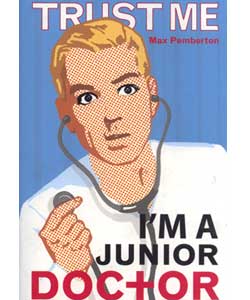
*Also, the fact that I misquoted the title in my original blog probably says something about my motivation to read it. Or Freud would say it references some sexual desire. Who knows.
AND, part of this blog is I want it to feel like a community- medical wannabes helping eachother out... so if you've read any good books, let me know...
Subscribe to:
Comments (Atom)